
CCC Release Destinations
Calcasieu Correctional Center is a parish jail operated by the Calcasieu Parish Sheriff’s Office. It holds people awaiting adjudication, which means the court has not yet resolved the charge, as well as people serving parish time. A person may leave CCC for the community after bond, recognizance, dismissal, time served, sentence expiration, or another court order. The same roster removal may instead mark a transfer to Calcasieu Sheriff’s Prison, another parish jail, Louisiana Department of Public Safety & Corrections custody, a hospital, court, a forensic or rehabilitation setting, or federal immigration custody.
The destination controls what to check next. A community release should have a local release entry with a date, time, authority, type, and destination. A transfer closes or changes the CCC custody entry but does not mean the person is free. CPSO Prison Transportation also handles court, hospital, forensic-hospital, and rehabilitation escorts. Those trips are institutional movements. The receiving-agency field in the release or transfer record is therefore far more useful than the mere fact that a name vanished from the roster.
Confirm a CCC Release
The official CPSO inmate roster is the quickest first check. It is a current-custody product. The researched feed displayed only records coded IN, and it did not show a release date, release reason, destination, sentence expiration, or rolling release window. If the person is listed, CPSO currently reports custody, subject to an update lag. If the person was listed before and is absent now, preserve the full name, date of birth, booking date, and inmate ID before moving through the verification chain.
- Search the CPSO roster again with the exact name and any known spelling variant. Do not treat a missing result as proof of release.
- Search Louisiana VINELink with the same identity. Read whether the event says release, transfer, custody, or community supervision.
- Contact CCC or CPSO Records and ask whether the status change was a community release or a transfer. Request the exact date, time, authority, reason, and destination when needed.
- Check the Calcasieu Clerk’s criminal case history and minutes for the court event behind bond, dismissal, sentencing, or completion.
A VINE status alert is useful evidence, but it is automated. A court minute proves what a judge ordered, while the CCC release record documents the operational event. When exact timing or destination matters, those sources should be read together. The broader Calcasieu Parish released-inmate search also explains the state, federal, and immigration branches when the person moved beyond CPSO custody.
Note: CPSO does not publish an official rolling list of CCC releases from the last 24 or 72 hours.
CCC Release Record Fields
CPSO identifies its Records Department as the unit that interprets and administers sentences, calculates parish release and expiration dates, maintains active-case information, and communicates with courts and correctional agencies about admission and release. That makes Records the strongest local source when roster absence could mean either freedom or transfer. A useful request ties the desired fields to one booking instead of asking the custodian to research or create an explanation.
| Field to request | What it resolves |
|---|---|
| Release date and time | When CPSO ended or changed the booking custody event |
| Release type or reason | Bond, court order, time served, sentence expiration, or another recorded basis |
| Releasing authority | The court, sentence administrator, or other authority behind the event |
| Destination or receiving agency | Community release versus transfer to another custodian |
| Booking and inmate identifiers | Links the answer to the correct person and booking |
Submit a narrow written request through the CPSO GovQA public-records portal. Include the full name and aliases, date of birth if known, approximate booking or arrest range, inmate or booking ID, and CCC as the facility. Ask for electronic copies. No fixed CPSO production fee or universal turnaround was published in the accessible material, so request a cost estimate. Pending-investigation and privacy rules may require redaction.
CCC Records and Contacts
The facility contact and the records channel serve different needs. Use the CCC number for a current operational status question. Use the written portal when the release fact must be preserved or when the release type, destination, and authority are important. I.D. Records can help route a record or booking-photo request. Emergency lines should not be used for routine release verification.
Calcasieu Correctional Center
5410 E. Broad St.
Lake Charles, LA 70615
Facility: 337-491-3800
Commander: 337-491-3801
Corrections mailing address:
P.O. Box 2017
Lake Charles, LA 70602
CPSO I.D. Records: 337-491-3642
CPSO main: 337-491-3700
Have the person’s legal name, date of birth, booking date, and CPSO ID ready. Ask one precise question: whether the CCC entry ended in community release or transfer. For a durable response, follow the call with a GovQA request for the existing record fields. Louisiana public-records law generally permits inspection without charge, but copies and certification can carry reasonable fees.
CCC Bond and Court Records
Bond is a custody event, not the final outcome of the criminal case. CPSO says bond is normally attached to a charge within 48 hours, but payment, surety processing, multiple charges, warrants, other holds, and court orders determine when a person can actually leave. A bond on one count does not require release when another count, sentence, warrant, probation hold, or detainer remains.
The CPSO Court Records and Bonds page shows the local unit that processes parish criminal bonds, maintains defendant papers, and records dispositions. The official source is shown below.
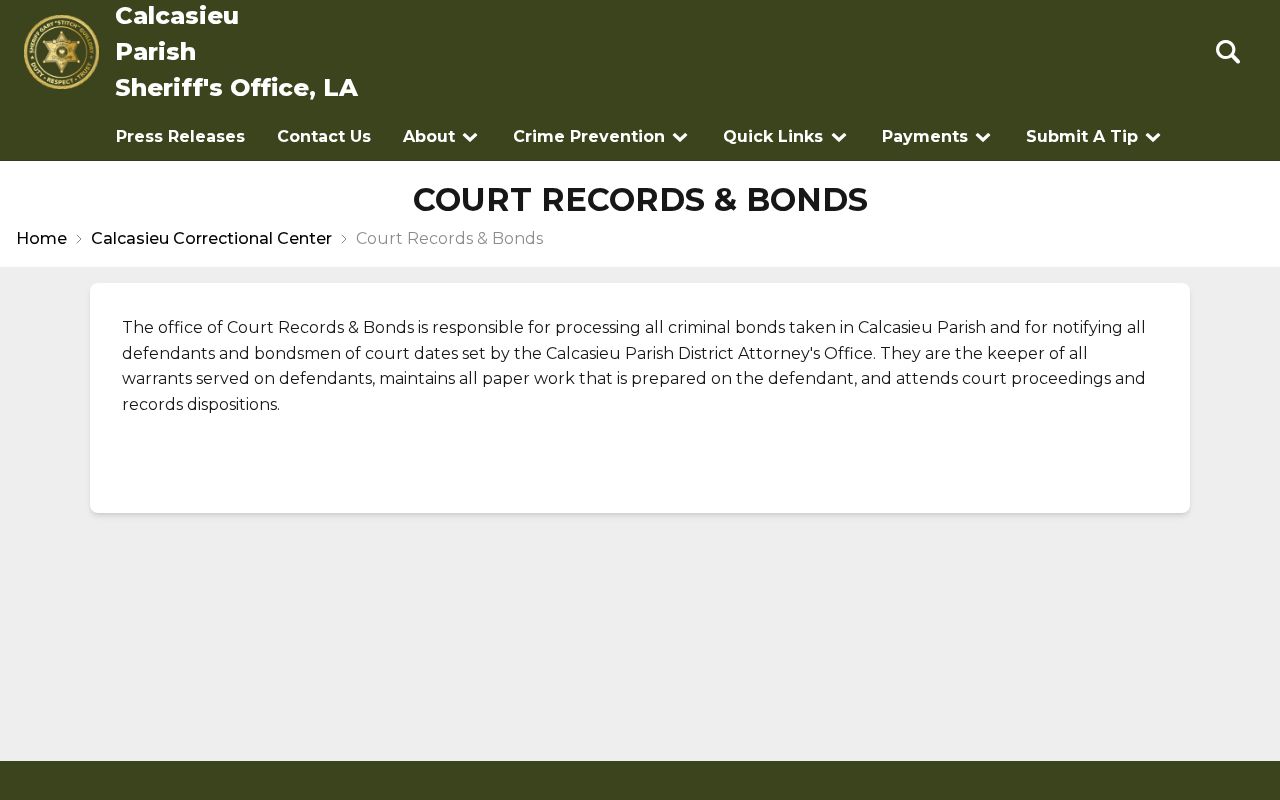
The court-and-bond material helps explain why a release may be expected, but CPSO Records supplies the jail’s actual release time and destination. The 14th Judicial District Court docket may remain open after bond. Also check Lake Charles City Court or Sulphur City Court when that court, rather than the 14th JDC, handled the charge.
CCC Custody and Transfers
The official Calcasieu Correctional Center page provides the facility information captured below.
The facility page confirms CCC’s place in the CPSO corrections system. Calcasieu Sheriff’s Prison and Women’s Correctional Services use the same central roster and records ecosystem, so movement among those buildings must be verified before it is called release. Physical location and legal custody can also diverge when a person receives a Louisiana state sentence but remains housed locally for a time.
- Community release
- CPSO custody ends and the person leaves for the community under the recorded authority and conditions.
- Transfer
- Custody at CCC changes, but another jail, state agency, hospital, court, or federal authority receives the person.
- Discharge
- The recorded end of a sentence or custodial obligation, which differs from a projected release date.
- Detainer
- A request or hold connected to another authority that may take custody when the local basis ends.
A person transferred into Louisiana DPS&C legal custody should be checked through VINELink and the state locator, even if the person stayed in a parish building for a period. If ICE takes custody, the CPSO entry may truthfully show release or transfer without a return to the community. Always name the authority whose custody ended and the authority that received the person.
State-sentence timing needs its own care. The Louisiana automated locator can report a facility assignment and a projected release date when one has been calculated. A projection is based on the sentence information and credits then known. It can change after official court papers arrive, jail credit is applied, good time is lost or restored, another sentence is added, or a detainer appears. The projected field should never be rewritten as an actual CCC release. After the date passes, check the custody status again and obtain the release or discharge record.
For an older state case that no longer appears clearly online, Louisiana law makes a discharge date and certain general sentence facts available on request from DPS&C. That state record answers when state custody ended. It does not replace the CCC booking record for the earlier parish event. Likewise, a parole or community-supervision result means incarceration ended while part of the sentence continues under supervision. Full discharge is a different result.
The court trail has a separate purpose. A certified sentencing minute establishes what the judge imposed, including time-served credit and whether terms run together or one after another. CPSO Records administers the parish calculation, and DPS&C administers the state calculation. Reading all three sources by role avoids a common error: using a court date as though it were the facility’s actual departure timestamp.