
CSP Release or Transfer
Calcasieu Sheriff’s Prison, often shortened to CSP, is operated by CPSO as a parish correctional facility. CPSO separately names CSP and Calcasieu Correctional Center, yet both are part of the same corrections network. Women’s Correctional Services is an annex in that system. The shared structure matters because a move from CSP to CCC can remove or change a building assignment without ending CPSO custody.
A direct community release may follow sentence expiration, time served, bond, dismissal, or a court order. Other departures can lead to another parish, Louisiana Department of Public Safety & Corrections custody, a hospital or treatment site, court, or ICE. A transfer is not a community release. The useful record is the one that names the receiving agency or destination, not a bare roster absence.
| Observed change | What it can mean | Best next source |
|---|---|---|
| Name remains on CPSO roster | Current CPSO custody is still reported, though the building may need confirmation | CSP or CPSO Corrections |
| Name disappears from roster | Release, transfer, data change, or lag | LAVINE and CPSO Records |
| State supervision appears | Incarceration may have ended while the sentence continues in the community | Louisiana DPS&C locator |
| Receiving agency is named | Custody continued with that authority | The receiving system |
Verify a CSP Release
Start with the CPSO current inmate roster. Its name, person ID, booking date, charges, photograph, custody code, and VINE link can establish that CPSO currently lists a person. The researched feed did not include a past-release window. It also lacked release time, release reason, destination, and sentence expiration. A missing name is therefore a prompt to verify, not the final answer.
- Match the person by full name, date of birth, booking date, and CPSO or VINE ID when available.
- Open Louisiana VINELink and search the same identity. Read the exact custody, release, transfer, or supervision wording.
- Call CSP or CPSO Records to ask whether the person entered the community or moved to another facility or authority.
- Use the Calcasieu Clerk’s case history and minutes to locate the bond, sentence, dismissal, or completion event.
Keep the claims separate. “CPSO no longer lists the person” describes the roster. “VINE reports release” describes an automated status. “The court ordered release” describes a judicial act. “CPSO’s release record states” is the strongest wording for the actual operational event. When systems disagree, ask Records for the date, type, authority, and destination rather than choosing one screen.
Request CSP Release Records
CPSO Records interprets and administers sentences, calculates parish release and expiration dates, maintains active-case information, and communicates with courts and correctional agencies. That central role applies even though CSP has its own facility phone. A narrowly framed request is more useful than asking why someone disappeared. It also gives the custodian a booking and a defined set of existing fields to locate.
Use the CPSO GovQA portal. Provide full legal name and aliases, date of birth if known, booking or arrest range, person or booking ID, and Calcasieu Sheriff’s Prison as the known location. Ask for an electronic copy of the booking summary and fields showing release date and time, release type or reason, releasing authority, destination or receiving agency, sentence-calculation or expiration entry, and booking photograph if needed for the record.
CPSO did not publish a fixed production charge or a universal response time in the researched portal. Ask for a fee estimate. Louisiana law generally permits free inspection and reasonable copy fees. Pending-investigation, privacy, sealed, and other restrictions may lead to withheld or redacted parts. If a field is withheld, ask for the legal basis and the segregable public portion.
Note: The live roster’s visibility period is not a published retention rule for the underlying CSP booking and release files.
CSP Release Contacts
Use the CSP line for a current location or operational question. For a written release trail, use central CPSO Records and GovQA. The commander line is a facility contact, not a substitute for the public-records portal. Routine release checks should never be routed through an emergency number.
Calcasieu Sheriff’s Prison
5300 E. Broad St.
Lake Charles, LA 70615
Facility: 337-431-1300
Commander: 337-491-3763
Corrections mailing address:
P.O. Box 2017
Lake Charles, LA 70602
I.D. Records: 337-491-3642
CPSO main: 337-491-3700
Before calling, collect a full name, date of birth, approximate booking date, and known identification number. Ask whether the person is at CSP, elsewhere in the CPSO complex, released to the community, or transferred. If the answer must be cited later, request the operative record in writing. The central records chain avoids treating two neighboring CPSO facilities as two separate custody systems.
CSP Facility Record Source
The official Calcasieu Sheriff’s Prison page identifies the facility and its place within CPSO Corrections.
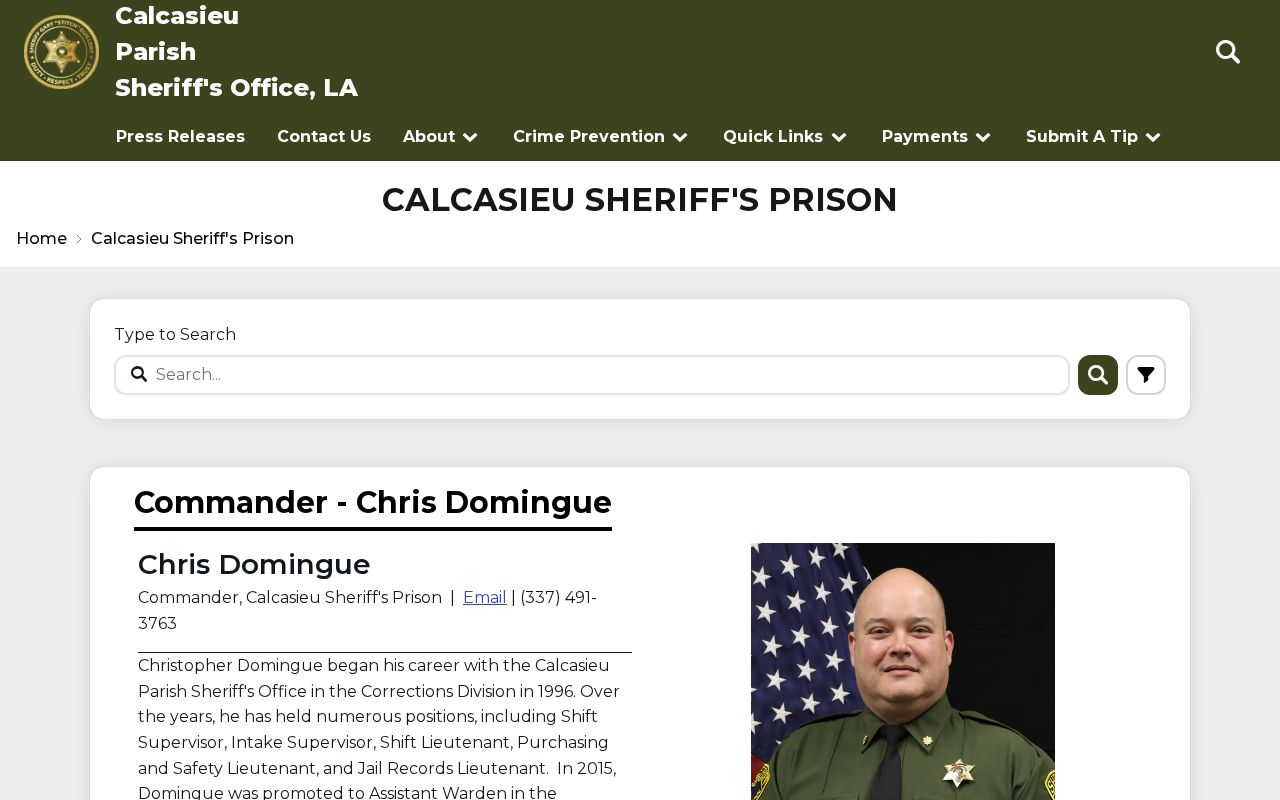
The facility source anchors the building name and contact. It does not provide a historical CSP release feed. Searchers should pair it with central Records, LAVINE, and court minutes instead of inferring a release from an address change.
A person serving a Louisiana state sentence may remain physically housed in a parish facility. In that situation, building location and legal custody differ. Search the Louisiana DPS&C route for the state assignment and projected date, then use a discharge or transfer record for the historical outcome. Do not calculate a state release merely from the sentence shown in a local court minute.
CSP 72-Hour Clarification
Calcasieu searches often encounter the phrase “72-hour court.” The CPSO corrections FAQ explains a Right to Counsel Hearing, not a report of people released during the prior three days.
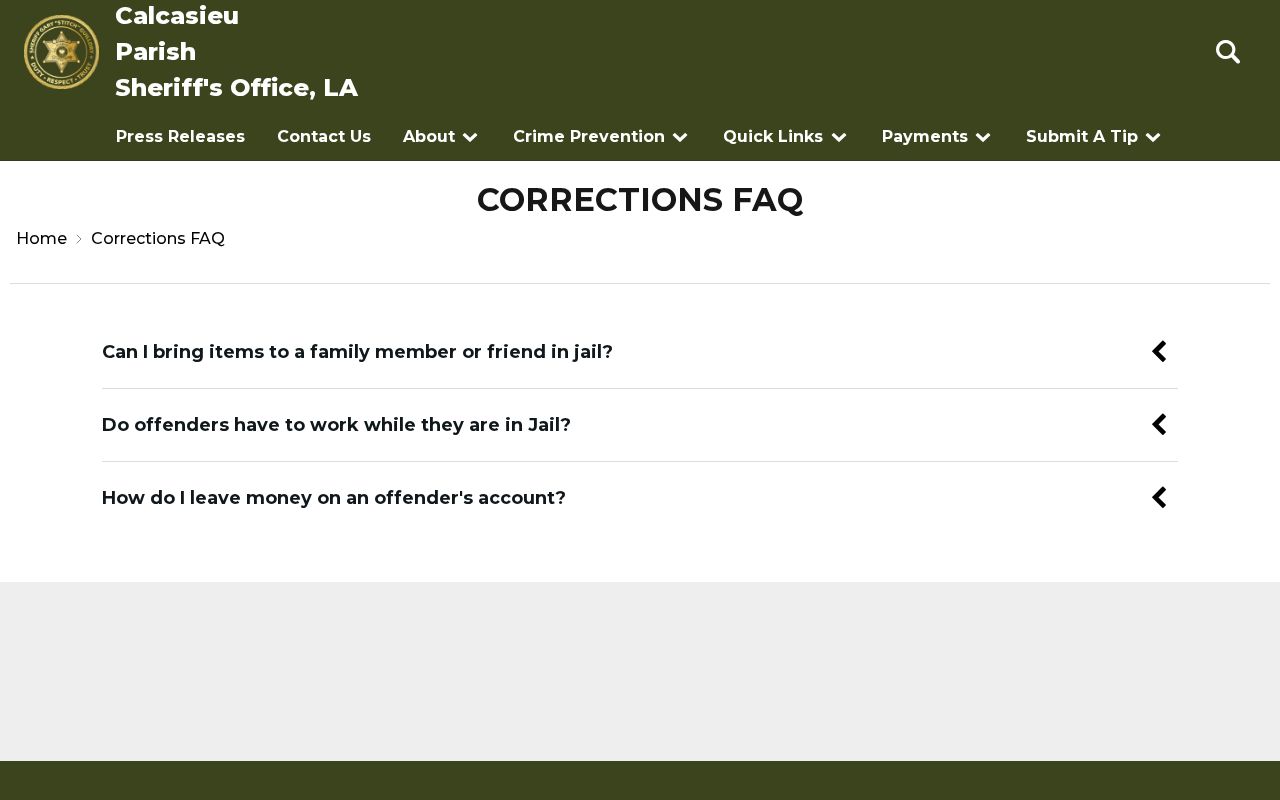
The FAQ helps prevent a common mix-up. No distinct official CSP 24-hour or 72-hour release list was located. Bond is normally attached to a charge within 48 hours, but that statement is not a promise that release occurs in that time. Other charges, warrants, sentences, holds, and processing can keep custody in place.
The court docket can show a bond decision or hearing. CSP Records shows whether and when the jail carried out the custody change. For a named person, the Calcasieu Parish release-record workflow brings the local, state, court, and federal branches together without turning the 72-hour hearing into a release feed.
CSP Custody Terms
Release language should describe the legal event precisely. Similar words can point to very different outcomes, especially at a parish facility that may house people under more than one authority.
- Time served
- A sentence or credit outcome based on time already spent in custody. It does not by itself mean the charge was dismissed.
- Transfer
- A move to another building or authority while confinement or legal custody continues.
- Parole
- Release from incarceration to serve the rest of a sentence under DPS&C supervision.
- Discharge
- The documented end of the relevant sentence or custody obligation, distinct from a projected date.
An ICE detainer can produce two events: release from CPSO authority and pickup by ICE. A state sentence can likewise shift legal custody to DPS&C while the person remains in a parish bed. Naming the releasing and receiving authorities prevents a CSP departure from being reported as freedom when another custodian took over.
CSP State Custody Records
A Louisiana state sentence changes the search path even when a person remains at CSP for a time. Begin with the certified court minute to confirm the sentence, time-served credit, and whether terms are concurrent or consecutive. Then use the Louisiana locator for the state facility assignment and projected date. DPS&C says a missing projected date can mean the official sentencing papers have not arrived or computation is not complete.
The automated state line uses the DPS&C number or a name plus date of birth. Its projected date is not an actual release record. Credits, disciplinary action, later court orders, new sentences, detainers, and the receipt of official paperwork can change it. After the projected day, verify the current status and destination. A community-supervision assignment indicates release from incarceration while sentence supervision continues; a discharge date records a different endpoint.
Historical state information may require a written DPS&C request. Louisiana law makes the discharge date and certain general sentence and disposition facts available even though much of an offender file remains confidential. That state request does not replace the earlier CSP record. Ask CPSO for the local release or transfer event and DPS&C for the later state outcome, then connect them with the sentencing court’s record.