
Juvenile Release Access Limits
Calcasieu Parish Juvenile Detention Center is a secure juvenile detention facility operated through the Calcasieu Office of Juvenile Justice Services, or OJJS. Juvenile cases use a distinct legal and records system. Public access is restricted to protect youth information. Adult custody tools should not be used to infer whether a child is detained, transferred, returned to a parent or guardian, placed through a court order, or released under juvenile supervision.
No public juvenile roster is documented for the facility. That is an access boundary, not a missing feature to work around. A blank internet search or absence from an adult database must never be described as proof of release. The youth’s parent or legal guardian, attorney, and the juvenile court can use the channels permitted for that case. Other callers may receive only general facility information or no case-specific information.
Confirm a Juvenile Release
The correct route begins with authority to receive the information. A parent or legal guardian should have identifying and case details ready and contact OJJS. Counsel should use the agency and juvenile-court record tied to the case. If the caller does not have a legally recognized relationship, the agency may decline to confirm whether a youth is or was held.
- Identify the youth accurately and gather the case number, court, and attorney information if known. Do not send private youth details through an unrelated public search form.
- Call OJJS or the Juvenile Detention Center and explain the caller’s relationship to the youth. Follow any identity-verification or authorization process the agency gives.
- Contact the youth’s attorney for the court order, placement change, release terms, and the next required appearance or service.
- Use the juvenile court channel authorized for the case. Ask for lawful access to the specific order or notice rather than requesting an adult-style booking history.
A juvenile release can involve return to a parent or guardian, a placement decision, services, supervision, or another court-directed outcome. The research does not publish a standard public release label or open field inventory for these events. The responsible agency and counsel must explain the individual order. Do not reuse adult terms such as parish sentence expiration unless the youth’s authorized record uses them.
Note: Facility staff can explain lawful routing without disclosing protected facts to an unauthorized caller.
Juvenile Center Release Contacts
The Calcasieu Office of Juvenile Justice Services contact page is the primary official route. The facility operates continuously, but round-the-clock operation does not mean all records or case staff are available at every hour. Use the detention number for an urgent authorized facility question and the OJJS number or email for agency routing.
Calcasieu Parish Juvenile Detention Center
3615 E. Prien Lake Rd.
Lake Charles, LA
Detention Center: 337-721-3960
Office of Juvenile Justice Services:
337-721-3900
ojjs@calcasieu.gov
Secure facility operation: 24 hours
Keep the communication narrow. State the caller’s identity and relationship to the youth, provide the case number if known, and ask which authorized person can address the release or placement order. Avoid sending medical, victim, family, or other sensitive facts until the agency provides an approved channel. When counsel is appointed or retained, counsel is often the clearest source for what the court ordered and what must happen next.
Juvenile Record Boundaries
Adult booking records in Louisiana can include public summary fields, subject to exemptions. That framework should not be copied onto juvenile detention. Juvenile identity, allegations, placement, medical needs, victims, and court material may be restricted. The public-records principle of requesting a segregable portion does not create a right to obtain protected youth details.
| Question | Proper juvenile source | What not to use |
|---|---|---|
| Is the youth currently at the center? | OJJS or facility, when the caller is authorized | Adult CPSO inmate roster |
| Did the judge authorize release or placement? | Youth’s counsel and juvenile court | Adult criminal case portal |
| Who may receive the youth? | OJJS, counsel, and the governing order | Assumptions from public search results |
| What happens after detention? | Authorized case team and court instructions | Adult parole or probation locator |
If an agency cannot disclose a case fact, do not try to reconstruct it through social posts, adult criminal systems, or the records of relatives. A lawful denial or privacy limit should be respected. The safe response is to confirm the correct office and let an authorized participant obtain the information.
Juvenile Facility Jurisdiction
The successful facility-related image in the manifest comes from the Louisiana DPS&C facility directory. It is shown only to clarify the boundary between the adult state corrections directory and the Calcasieu juvenile facility.
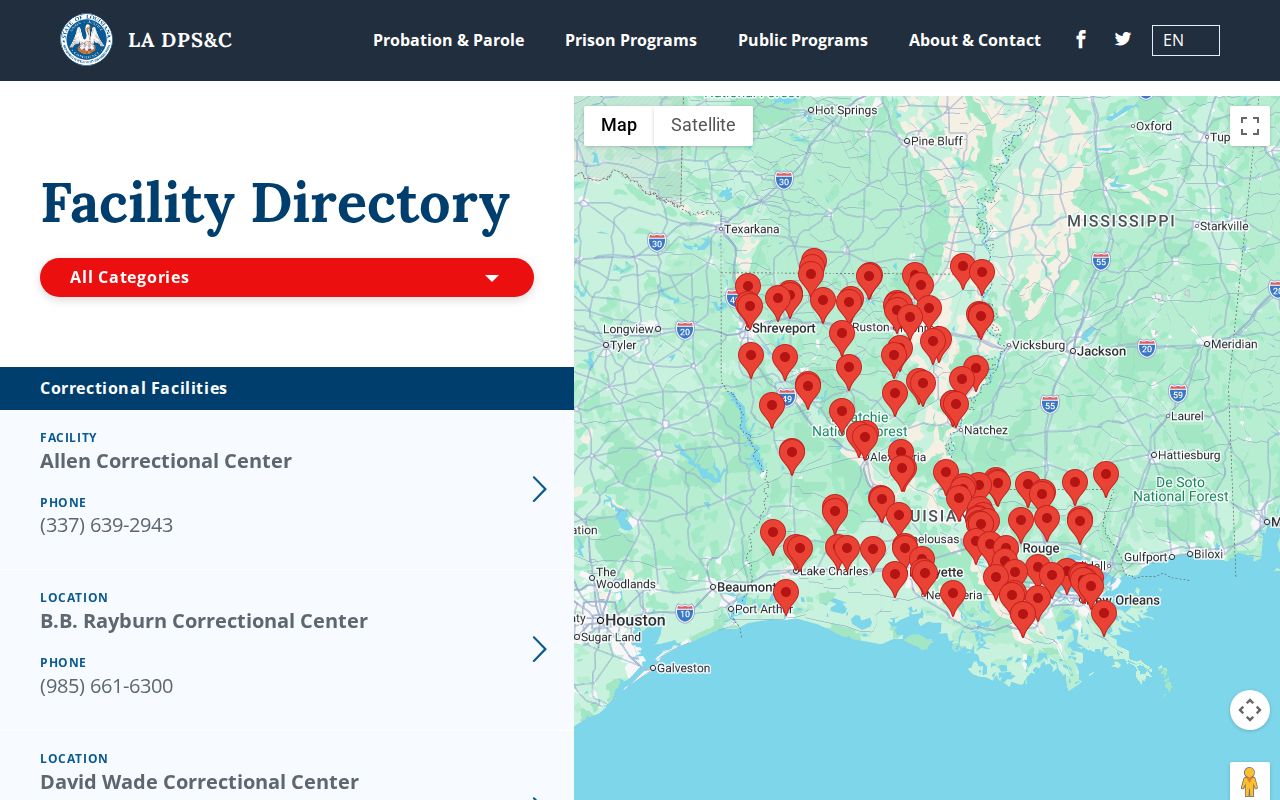
This image depicts the state corrections facility directory. It does not depict the Juvenile Detention Center, its interior, or a youth record. The directory helps show why an adult DPS&C facility search is not the correct route for a youth held by Calcasieu OJJS. The facility contact page, counsel, and juvenile court remain the proper sources.
No Louisiana state prison or federal correctional institution was identified inside Calcasieu Parish during the research. That adult facility finding does not change juvenile jurisdiction. The Calcasieu Parish Juvenile Detention Center is separately operated through local juvenile justice services and should not be described as a parish adult jail or state prison.
Juvenile Release Meaning
“Release” in a juvenile case may not mean an unconditional return home. It can be tied to the court’s placement, supervision, service, or guardian instructions. Public research did not identify a universal schedule, open release log, public field list, or set processing time for the Calcasieu facility. Those gaps must not be filled with adult jail assumptions.
- Guardian
- A person with legal authority and responsibility for the youth, as recognized by law or court order.
- Placement
- A court or agency-directed setting for the youth. A change of placement is not necessarily an unrestricted release.
- Counsel
- The attorney representing the youth and able to explain the case order and lawful next steps.
- Restricted record
- Information whose access is limited by law, court rule, or privacy protections.
The exact order controls. A staff statement about general procedure cannot replace the case document. Parents and guardians should ask counsel about timing, the person authorized to receive the youth, the next court event, and any required services. No one should infer those terms from when a name does or does not appear online.
Separate Youth and Adult Records
Calcasieu’s adult released-inmate resources cover CCC, CSP, the Women’s annex, Louisiana adult corrections, and other adult custody branches. They are not a back door to juvenile information. A young person’s privacy should remain intact even when an adult relative appears in another record system.
The same separation applies to state victim-notification tools, public sex-offender registries, federal locators, and immigration databases. None should be presented as a routine juvenile release route. If another authority becomes involved in a particular youth’s case, counsel and the governing court can identify the lawful source and explain who may access it.
For an adult at another Calcasieu facility, the Calcasieu Parish release verification path explains CPSO Records, LAVINE, and court minutes. For a youth at this center, stop at the OJJS, counsel, and juvenile-court boundary. That distinction protects accuracy as well as privacy.
Prepare for Juvenile Release
An authorized parent or guardian can make the agency call more useful by gathering the youth’s full legal name, date of birth, case number, attorney’s name, and court information before contacting OJJS. These details should go only through the channel the agency approves. The goal is not to build a public history. It is to connect the authorized adult with the order and staff responsible for the youth’s lawful transition.
Ask what document controls the next step, who is permitted to receive the youth, and whether counsel must clarify any term. Also confirm the next court date or service contact directly from the authorized case source. Do not assume that a planned date is final. A judge, placement issue, or case-specific condition may change what happens, and the public research offers no standard timetable.
If two authorized sources appear to conflict, contact counsel and the facility rather than selecting the answer that suggests the earliest release. Record the office, date, and general instruction without publishing youth details. A court order and agency confirmation should guide the family. Public rumor, a social post, and absence from an adult roster should play no role.