
Calcasieu VINELink Release Coverage
Louisiana calls its statewide victim information and notification network LAVINE, while some DPS&C material uses LAVNS. The Louisiana Commission on Law Enforcement manages the service with parish sheriffs, district attorneys, and Louisiana DPS&C. Official material says the network monitors adults in all parish jails and state prisons. CPSO's live roster links individual records directly to VINELink.
VINELink performs two related functions. A one-time search reports the automated custody, location, or supervision information currently associated with a matched person. Registration asks the system to send later event notices. Calcasieu Correctional Center, Calcasieu Sheriff's Prison, and the Women's Correctional Services annex use the common CPSO ecosystem, so a building change may appear as a transfer or location change rather than a release.
Juvenile detention must not be searched through adult methods. Federal Bureau of Prisons and ICE custody also fall outside LAVINE's parish-jail and state-prison scope.
Search Calcasieu VINELink Records
Identity matching comes first. Obtain the full legal name, aliases, date of birth, approximate booking date, and any CPSO, VINE, or DPS&C number. A name alone can collide with another record. Search location and status only after confirming that the result belongs to the intended person.
- Open Louisiana VINELink and choose the person or offender search.
- Enter the full name or ID/case number. Narrow by Louisiana location where the interface offers it.
- Compare the returned identity, identifier, and known booking or agency facts. Do not choose the first name match by default.
- Open the matched record and read the exact custody status and facility or supervision location.
- Save the access date and status wording. If precision matters, confirm the event with CPSO or Louisiana DPS&C.
The official Louisiana person-search screen shows the interface used to begin this identity match.
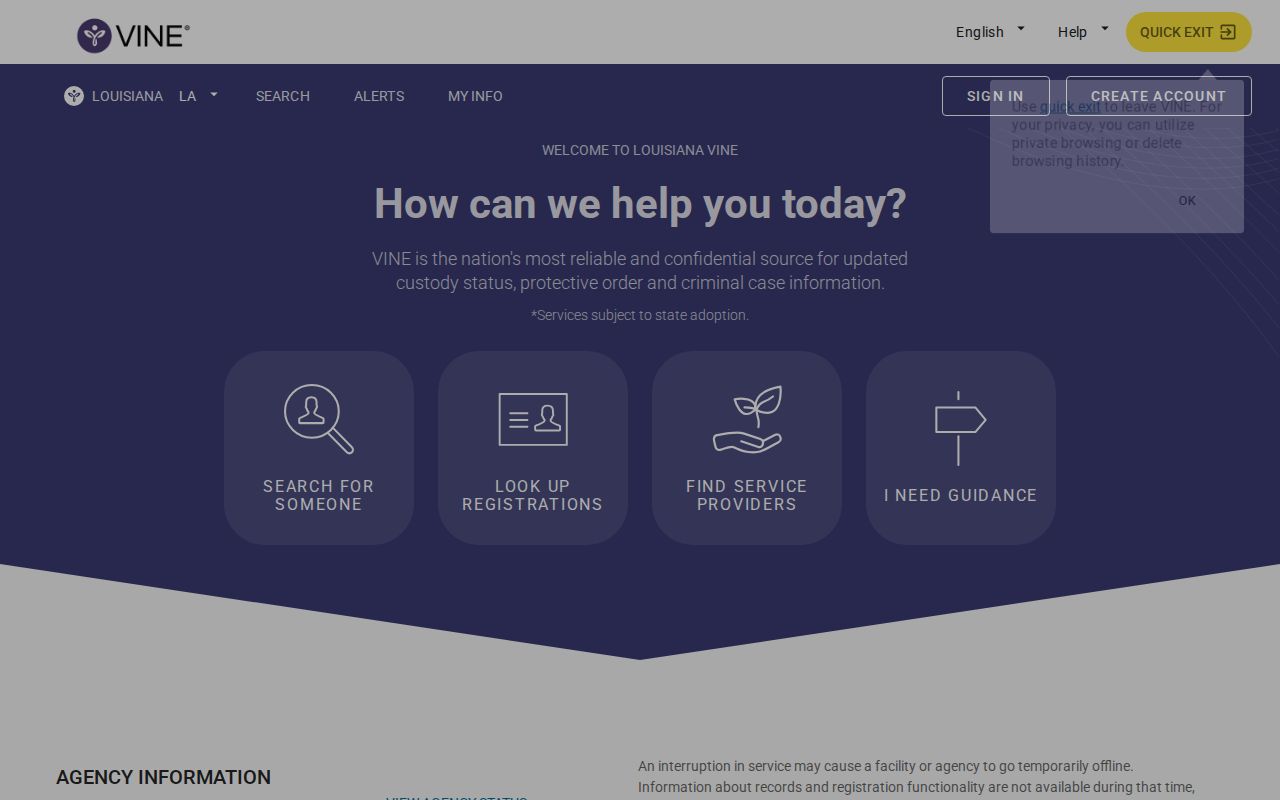
The screen is a starting point, not a certified record. A privacy-safe capture should avoid publishing an unrelated person's details.
Calcasieu VINELink Release Fields
The exact fields vary by contributing agency and record type. Read what is displayed rather than filling gaps by inference. A CPSO result may describe current jail custody or a status change. A Louisiana DPS&C result may show imprisonment or community supervision. State telephone information can also include the exact field “projected release date (if applicable),” but a projection is not an actual release.
| VINELink field or event | What it can support |
|---|---|
| Name and ID/case number | Helps match the result to the correct person. |
| Custody status | Reports the automated state of the contributing record. |
| Facility or location | Identifies a jail, prison, or supervision office where available. |
| Supervision status | May show probation or parole after incarceration ends. |
| Release event | Reports an automated change away from the former custody status. |
| Transfer event | Shows a location or custodian change, usually with confinement continuing. |
A person on community supervision is outside the prior prison but not fully discharged. By contrast, a DPS&C discharge date is historical general information available through the state records process. For CPSO, the sheriff's release entry is the better source for exact release type, time, authority, and destination.
Note: Describe an automated result as “VINELink reports” and add the access time rather than converting it into an agency-certified statement.
Register Calcasieu Release Notifications
Registration begins from the correct person's record. The service may prompt the user to sign in or create an account. Choose only channels offered by the live interface, keep contact details current, and use a second method when practical. Notices can cover release, transfer, or another custody change, so event wording remains essential.
- Open the identity-matched Calcasieu Parish or Louisiana DPS&C record.
- Select notifications and choose telephone, text, email, app, or TTY as offered.
- Add the contact destination and confirm any channel-specific prompts.
- Create a private four-digit PIN for telephone notices. The PIN confirms receipt; it is not an inmate ID.
- When a call arrives, enter the PIN to stop repeat calls. Without confirmation, VINE may leave a message and keep calling for at least 24 hours.
- Read whether the notice says release, transfer, escape, or another change, then confirm with the contributing agency.
Louisiana assistance is available at 866-528-6748. National VINE help is 866-277-7477, and TTY help is 866-847-1298. The official VINE registration instructions explain delivery methods and telephone confirmation. These support routes do not replace CPSO or DPS&C as the source of the underlying custody record.
Calcasieu Transfer Alert Meaning
A transfer notice must be read literally. It means the origin facility, location, or custodian changed. Confinement usually continues. A move between CCC and CSP may remain within CPSO. A CPSO-to-DPS&C transfer should lead to a state locator trail. An ICE pickup requires the separate ICE locator, and a transfer to another parish belongs with that sheriff.
Same-day timing can be uneven. Louisiana DPS&C says its public information is updated every 24 hours, and state law warns that automated notification data may not be accurate, timely, or complete. A VINE event is useful contemporaneous evidence, but the agency release or transfer record is stronger when the legal authority and destination matter.
- Release
- The reporting system says the prior custody status ended, subject to agency confirmation.
- Transfer
- Custody or location changed and confinement may continue.
- Parole
- Incarceration ended while the sentence continues under supervision.
- Discharge
- The relevant state custody or sentence status ended as shown by a historical record.
Louisiana Victim Outreach Registration
Louisiana maintains a distinct formal notification path through DPS&C Victim Services. Eligible registrants may receive notices about projected and actual state release, transitional work, escape, and parole or pardon proceedings. That function is not the same as a public VINELink registration.
A person who registered with a local agency should not assume that registration moved automatically into the state Victim Outreach program after sentencing. Likewise, an ordinary VINELink alert does not prove enrollment in formal victim services. Follow each program's current instructions and do not promise eligibility.
This local distinction matters when a Calcasieu Parish case becomes a Louisiana DPS&C sentence. The sheriff's custody record, public LAVINE search, and formal Victim Outreach notice may all concern the same person while serving different purposes.
Note: Keep both registrations current when each program applies, because one public alert does not substitute for formal state victim notification.
Confirm Calcasieu VINELink Releases
VINELink is not a certified archive. R.S. 15:1229 limits governmental liability for automated information's accuracy, timeliness, and completeness. An unmatched search is not proof of release. Old state discharges may no longer be easy to find, and federal or immigration events require different systems.
For a CPSO booking, call Calcasieu Correctional Center at 337-491-3800 or CPSO at 337-491-3700. Request the booking and release entry through GovQA when exact type, time, authority, or destination must be documented. Court minutes can support the legal event but may not record the jail's completed processing time.
For Louisiana state custody, the automated locator at 225-383-4580 accepts a DPS&C number or name plus date of birth. It can report an assigned facility and a projected date when applicable. A projected date can change. Historical discharge information may require a DPS&C public-information request.
Match a VINELink result to more than a name. Compare the available ID or case number, date of birth, location, and agency before registering. Similar names and spelling changes can lead to the wrong record. Save the event wording and time without republishing unnecessary personal data. When a release alert arrives, check whether another custodian is named and then request the source record if the reason or destination must be preserved.
Telephone, text, email, app, and TTY notices can have different confirmation steps. The four-digit PIN belongs to telephone delivery, where it confirms that the call was received and stops repeated attempts. Without confirmation, VINE may leave a message and continue calling for at least 24 hours. Do not require that PIN for a channel whose live interface does not request one. Keep a second contact method current when practical, because a changed number, full inbox, or blocked message can prevent delivery even though the underlying agency event was recorded.
Beyond Calcasieu VINELink Coverage
A federal result belongs in the BOP record system, which can display “Released” or “Not in BOP Custody” for its own records. Those terms address BOP custody only. The USMS prisoner role covers federal pretrial custody, but USMS has no comparable public person locator. Use the federal docket or an existing-record FOIA request when needed.
ICE's Online Detainee Locator covers current detainees and, under the researched guidance, people released from ICE within the prior 60 days. A CPSO release under an ICE detainer may be a handoff into immigration custody. A negative ICE result still does not prove community release. Match exact identity and country of birth, then use ICE's help line when needed.
The Calcasieu Parish released-inmate search routes those county, state, federal, and immigration branches. VINELink remains the best one-person notification path for the adult parish and Louisiana state systems it actually covers.