
Women’s Annex Release System
Women’s Correctional Services is not documented as an independent jail with a separate public database. CPSO names it as an annex in the same corrections system as Calcasieu Correctional Center and Calcasieu Sheriff’s Prison. That means a search should begin with the shared CPSO roster and continue through central Corrections Records. Searching only the annex name can miss the person when the public record uses the broader CPSO location or when the person moves to another part of the complex.
A woman may return to the community after bond, recognizance, dismissal, time served, sentence expiration, probation, or another court order. She may also leave the annex because CPSO moved her elsewhere, Louisiana DPS&C accepted legal custody, another jail received her, or a medical, court, or federal authority took custody. Each event can end the annex assignment. Only some are releases into the community.
Confirm a Women’s Annex Release
Use the CPSO inmate roster for the first current-status check. The researched roster carried names, photographs, booking data, charges, person IDs, and a status-notification link. Every reviewed custody code was IN. The source did not contain a release date, release type, destination, or 24-hour and 72-hour release windows. Removal from the roster cannot distinguish release from transfer or a data update.
- Search the CPSO roster using the legal name and any known alias. Match the date of birth, booking date, and person ID when available.
- Search Louisiana VINELink for the same person. Read whether the status is custody, release, transfer, or community supervision.
- Ask CPSO Corrections Records whether the annex status ended in a community release or movement to another building or agency.
- Check the sentencing court’s minutes for bond, dismissal, sentence, probation, modification, or completion.
These systems do not prove the same fact. The roster addresses present CPSO visibility. VINE gives an automated status indication. The court docket records legal action. CPSO’s booking and release record supplies the date, time, type, authority, and destination. A strong finding states which source supports each part.
Note: A facility-change notification usually signals continued custody and should not be relabeled as release.
Women’s Annex Record Request
CPSO Records calculates parish release and sentence-expiration dates, administers sentences, keeps active-case information, and communicates with courts and correctional agencies. That role makes central Records the right custodian for an annex release question. The absence of a separate annex portal does not mean the event went undocumented.
Submit the request through the CPSO GovQA public-records portal. Identify the person by full name, aliases, date of birth if known, booking or arrest date range, and inmate or booking ID. Name Women’s Correctional Services as the known facility assignment, but allow for records indexed under CCC, CSP, or CPSO Corrections. Ask for electronic copies of existing fields instead of asking the custodian to form an opinion.
| Requested record field | Reason it matters |
|---|---|
| Booking date and identifier | Confirms the correct annex-related custody episode |
| Release date and time | Documents when CPSO processed the change |
| Release type and authority | Separates bond, sentence completion, court order, and other bases |
| Destination or receiving agency | Distinguishes community return from continued custody |
| Sentence expiration entry | Shows the parish calculation when one exists |
No fixed CPSO production fee or universal turnaround was published in the research. Ask for an estimate. Pending investigations, medical information, victim identifiers, sealed matters, and other protected material may be withheld or redacted. Request the public portion and a written legal basis for any denial.
Women’s Annex Release Contacts
CPSO publishes central corrections and records contacts rather than a separate Women’s Correctional Services release desk. Use the main and records channels for routing. If the person may be at CCC or CSP, ask the caller to confirm the building assignment as well as the legal custodian. A written GovQA response is best when the event must be preserved.
CPSO Corrections and Records
CPSO main office:
5400 E. Broad St.
Lake Charles, LA 70615
337-491-3700
info@cpso.com
Corrections mailing address:
P.O. Box 2017
Lake Charles, LA 70602
I.D. Records: 337-491-3642
CCC routing line: 337-491-3800
The official CPSO contact directory is shown in the captured source below.
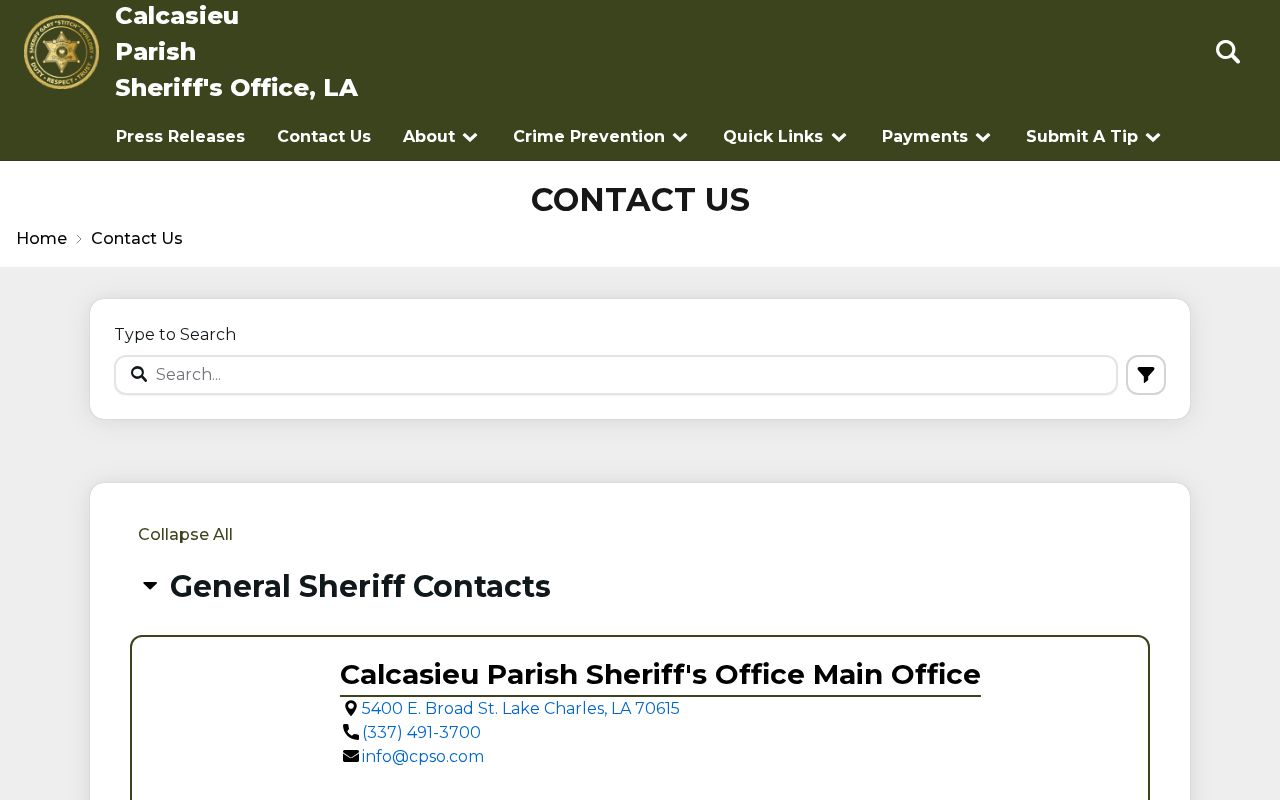
The directory supports central routing for the annex. Prepare the legal name, birth date, booking range, and ID before calling. Ask whether the person left CPSO custody for the community or transferred, and request the receiving agency when the record permits disclosure.
Women’s Annex Transition Programs
CPSO documents treatment and transitional programming in its corrections operation. The official treatment-program source is captured below.
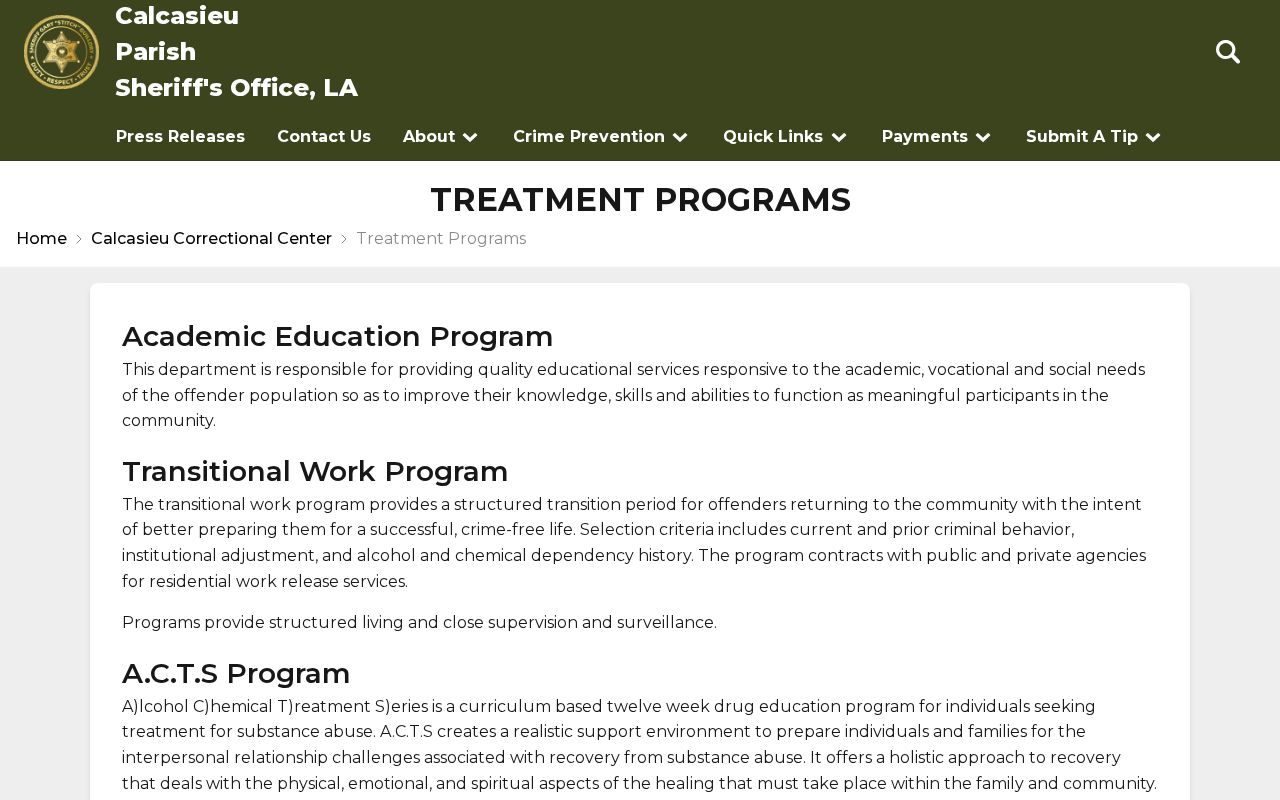
CPSO describes pre-release and transitional-work services for sentenced people returning to the community, along with substance-use education, literacy, life skills, AA or NA, and prison ministry. Participation can provide context for a planned transition, but it does not establish that a named woman was released or identify a release date. Only the custody status and operative record do that.
A person who enters Louisiana probation or parole may be assigned to the Lake Charles Probation and Parole District. Parole means release from incarceration to finish a sentence under supervision. Probation may follow a suspended or split sentence and does not always follow prison. A supervision result supports that incarceration ended while a legal sentence status continues. It is not the same as full discharge.
Women’s Annex Court Trail
The Calcasieu Clerk’s Criminal Index, Case History, and Minutes can show the legal event connected to release. Search the defendant, verify the docket and arrest date, and read the chronological entries for bond, dismissal, plea, sentence, probation, amendment, or completion. A bond release leaves the case open. A dismissal can explain why custody should end but may not state the jail’s exact door-out time.
Use the 14th Judicial District Court online services for the initial search. The Clerk states that online copies are not the official parish record; official records are held in its office. The 14th JDC also does not cover every Lake Charles City Court or Sulphur City Court matter. Search the court where the charge was filed rather than assuming the parish district court handled it.
- Bond
- A means of release from detention while the criminal case can remain pending.
- Time served
- Credit or a sentence outcome based on time already held, not a finding of acquittal.
- Transfer
- A change in facility or custodian while confinement continues.
- Discharge
- The documented end of the relevant sentence or supervision obligation.
If the court and roster differ, contact CPSO Records. Court minutes describe judicial action. The jail release entry records when CPSO acted and where the person went. The Calcasieu Parish released-inmate record path covers state, federal, and immigration branches when the next authority is outside the annex system.
Women’s Annex Custody Boundaries
Legal custody can change without an immediate move far from the annex. Louisiana permits some people sentenced to DPS&C custody to remain housed in a parish facility. In that case, the sentencing minute and state locator should be read together. A projected state release date is an estimate, not proof that the person left on that date.
An ICE detainer creates another boundary. CPSO may end its authority and transfer the person to ICE. The local record can accurately say release or transfer even though the person did not enter the community. Search the receiving system and use the destination field. The clearest wording always names the authority whose custody ended and the authority, if any, that assumed custody.
Women’s Annex Post-Release Records
A person under parole or probation can be outside the annex while still serving a sentence under Louisiana supervision. The public locator may show the assigned Probation and Parole district. Lake Charles District serves Calcasieu, Cameron, and Jefferson Davis parishes and handles many interstate cases because of the Texas border. The office assignment helps route a reporting question, but it does not expose every condition or private case detail.
Parole follows release from incarceration. Probation can arise from a suspended or split sentence and need not follow prison. Neither status is the same as full discharge. If the person no longer appears in a public locator, request the historical discharge date when the state sentence is relevant and check the court for a filed completion or termination record.
Calcasieu Parish also runs a Reentry Transit Program for people under DPS&C supervision who need scheduled rides to essential appointments such as probation and parole, court, medical care, classes, or groceries. It is not an on-demand ride from the jail gate, and participation does not prove an individual release. The program is local transition context, while Records and the court remain the proof sources.