
No Calcasieu 72-Hour Release Feed
CPSO does not publish an official rolling list of people released during the last 72 hours. The sheriff's website and mobile app show current custody. They do not offer a three-day release archive, a release-date filter, or fields for reason and destination. The only local CPSO use of “72-hour” found in the research refers to a Right to Counsel Hearing, not a list of people who left jail over three days.
This absence changes the task. A three-day inquiry must reconstruct custody events across a date range. Start with the known booking, collect any status notices, then request the release or transfer entry. Court minutes can explain a bond, dismissal, sentence, or other order, but they may not show the exact time CPSO completed processing. A transfer may also occur after business hours without becoming a community release.
Rebuild Calcasieu Three-Day Releases
Define the period first. Write down the start and end date, the person's full name and aliases, date of birth, approximate booking date, and any CPSO or VINE identifier. This avoids blending two bookings or two people with similar names. Then build a dated event trail rather than relying on one present-day screen.
- Search the current CPSO roster for each known identity. Record only whether CPSO currently lists the person.
- Review the matched Louisiana VINELink record or saved alert. Preserve the event wording and time.
- Call CPSO Corrections or Records and ask whether the status change was release to the community or transfer to another authority.
- File a GovQA records request for the exact booking and the release date, time, reason, authority, and destination.
- Read court minutes in date order. Use the court that handled the charge, which may be the 14th JDC, Lake Charles City Court, or Sulphur City Court.
The Released Last 24 Hours workflow is better when the event happened today and immediate confirmation matters. The three-day method emphasizes reconstruction across multiple dates.
Calcasieu 72-Hour Record Fields
A true rolling release list would need fields that CPSO's public roster omits. The absence of those fields is why the current roster cannot be converted into a release feed. A narrow request should ask for existing records tied to one booking, not for CPSO to generate a custom three-day report.
| Needed field | Why it matters across three days |
|---|---|
| Full name and person ID | Connects the event to the correct person and booking. |
| Booking date and time | Separates a new arrest from an older booking. |
| Release date and time | Places the custody change inside or outside the chosen window. |
| Release type | Distinguishes bond, time served, dismissal, sentence completion, or another basis. |
| Releasing authority | Names the court or agency linked to the action. |
| Destination | Separates community release from transfer to CCC, CSP, DPS&C, ICE, or another jail. |
A state discharge date and a CPSO release time are different records. So are a court's release order and the jail's completed release. Keep the issuing agency beside each date when building the three-day timeline.
Note: Ask for electronic copies and a fee estimate because CPSO did not publish a fixed production charge or universal turnaround.
Calcasieu Weekend Release Reconstruction
A three-day window is most useful when a question spans a weekend or another stretch in which offices may answer later. It does not prove that CPSO publishes a weekend batch. Court action, bond processing, sentence expiration, transport, and database updates can occur on different dates. The operative release record, not the day a name was noticed missing, fixes the parish custody event.
Build the sequence in plain terms: court action, CPSO processing, status change, and next destination. For example, a court minute may show that bond was ordered while another hold still kept the person confined. A later CPSO entry may show transfer to Louisiana DPS&C. Neither record should be shortened to “went home.”
The 14th JDC Clerk's online material is not the official record held in the office. When proof matters, request a certified minute. Also remember that the Clerk's phrase “released records” means records cleared for public viewing. It does not describe people released from custody.
Calcasieu Three-Day Roster Limits
Research on July 20, 2026 reviewed 1,080 entries in the official CPSO app data. Every entry had an IN code, and none included release time, reason, or destination. That finding shows why a roster snapshot cannot identify everyone who left during the prior three days. The public update cadence and post-release retention period were not stated.
The CPSO roster interface illustrates the present-focused source used for this limited check.
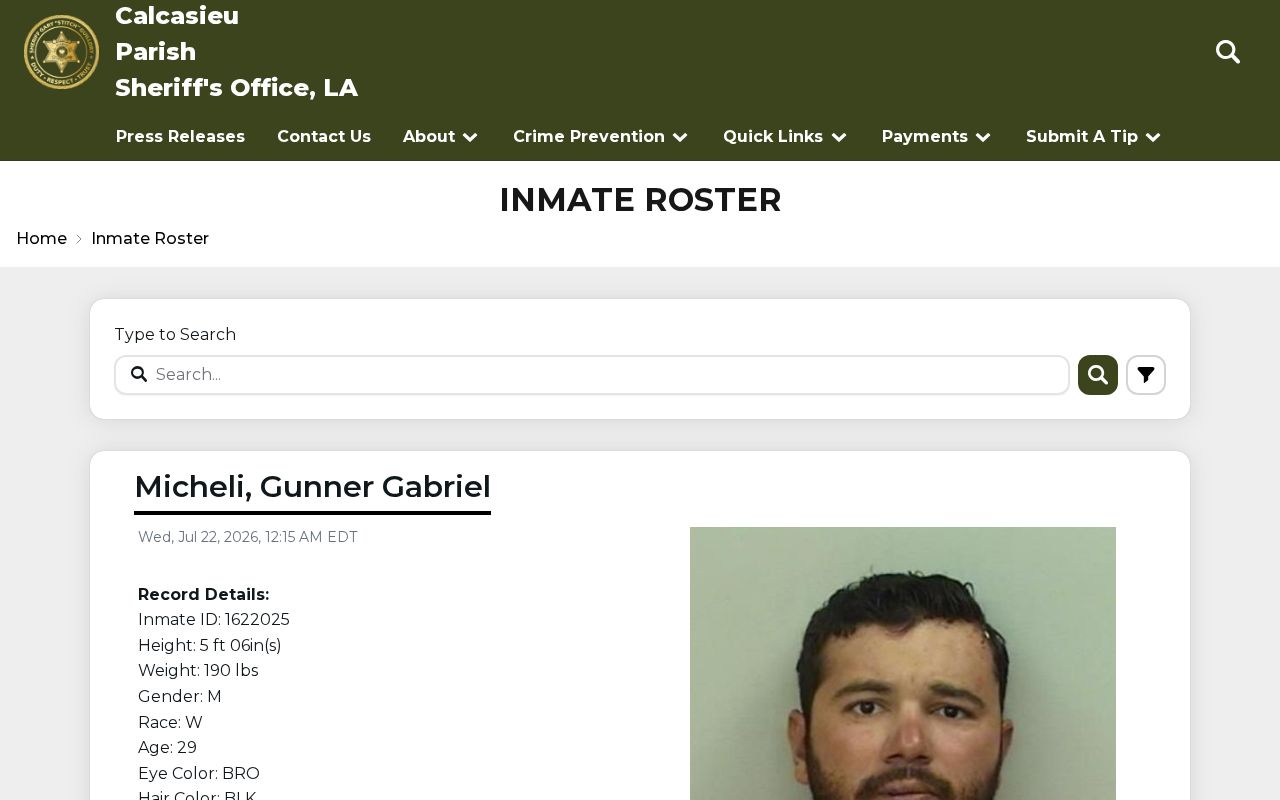
The image should be read as a current-custody screen. A person absent from it could have posted bond, completed a sentence, transferred, been picked up on a detainer, or disappeared because of a data change.
- Currently listed
- CPSO exposes a matching present-custody entry, subject to update lag.
- No longer listed
- The former entry is absent; the outcome remains unconfirmed.
- Transferred
- CPSO custody or location changed while confinement may continue.
- Discharged
- A historical record shows the relevant state custody or sentence status ended.
Resolve Calcasieu Release Conflicts
Three-day checks often expose sources with different dates. CPSO might no longer list a person while VINELink still shows a prior location. A court minute may order release before the jail completes checks. Louisiana VINELink refreshes on its own schedule and official state material describes a 24-hour update cycle. None of these differences should be resolved by choosing the most favorable date.
Record each source and access time. Call the custodial agency, identify the conflict, and ask whether another authority took custody. When exact proof is needed, request the operative CPSO release or transfer record. A written trail is especially important when the destination could be Louisiana DPS&C, another parish, ICE, or USMS.
A weekend court entry and a jail record may carry different timestamps without contradicting each other. The first can show when a judge signed or announced an order. The second records when jail staff completed identity, warrant, bond, sentence, property, and receiving-agency steps. Do not move either time merely to fit a three-day window. Report the source attached to each date and use the CPSO event field for the custody transition.
Note: Use “VINELink reports” for an automated result and reserve “released by CPSO” for an agency record or direct confirmation.
Calcasieu Three-Day Fallback Channels
CPSO Records is the strongest local source because that unit administers parish release and expiration dates and communicates with courts and correctional agencies. Calcasieu Correctional Center can be reached at 337-491-3800, CPSO main at 337-491-3700, and I.D. Records at 337-491-3642. A caller should have the legal name, date of birth, booking date, and person ID, then ask whether the entry represents community release or transfer.
For a state sentence, use Louisiana VINELink and the DPS&C automated locator at 225-383-4580. A community-supervision result means incarceration ended while sentence supervision continues. For old state history, request the discharge date from DPS&C. A federal case belongs in BOP or the federal docket. An ICE handoff should be checked in the ICE locator within its stated scope.
Court research should follow jurisdiction as well as date. The Calcasieu Clerk's Criminal Index, Case History, and Minutes cover 14th Judicial District Court matters, but Lake Charles City Court and Sulphur City Court cases must be checked in their own systems. Confirm the docket and arrest date before buying a page. A later minute may show a dismissal, amended sentence, probation termination, or completion that explains the custody path, while the jail record remains the source for the operational release time.
For one known person, the Calcasieu Parish released-inmate lookup lays out those custody branches. It avoids turning a three-day date range into an unsupported list of names.