
Calcasieu Projected Versus Actual Release
A projected release date is a current calculation based on the sentence, lawful start and credit dates, governing statutes, and credits earned so far. It can move. An actual release entry records the custody change after it occurred and should identify the date, time, reason, authority, and destination when those fields exist. Louisiana DPS&C uses the exact phrase “projected release date (if applicable)” in its automated locator.
Pretrial detention follows a different path. Someone awaiting adjudication has no sentence-based date to compute. Bond, dismissal, a plea, a court order, or transfer may control when custody changes. Court minutes can show that a judge ordered bond or release, but they may not record the jail's precise door-out time. CPSO Records is the local source for parish release and expiration calculations.
A bond entry ends detention only after the order, payment or recognizance terms, and jail processing are complete. The criminal case may remain active. “Time served” describes sentence credit, not an acquittal. A transfer closes a CPSO custody segment while another authority may take control. Those labels cannot be reduced to one projected-date rule.
A sentenced person housed in Calcasieu Parish may still be legally in DPS&C custody. Building location alone does not choose the right source. Identify the authority holding the sentence, then read the state or parish record that authority maintains.
Find Calcasieu Projected Release Dates
Start with the sentence and custody type. Louisiana's online search includes imprisoned people and people on community supervision, but the public phone locator is the source that expressly offers a projected release date when applicable. It is available around the clock at 225-383-4580. The caller needs a DPS&C number or a name plus date of birth.
- Collect the legal name, date of birth, booking or DPS&C number, sentencing court, offense date, and sentence date. Verify identity with more than a name.
- For state custody, search Louisiana VINELink for the current custody or supervision location. Then call the automated DPS&C locator for the projected field.
- If the person was just sentenced and no date appears, check whether official sentencing documents reached DPS&C. The agency warns that a computation may not yet be complete.
- For a parish sentence, contact CPSO Corrections or Records. Pair the calculation with the sentencing minutes from the correct court.
- After the date passes, verify the actual status through the custodian, VINE, and the release or discharge record. Do not convert an old projection into a claim of release.
The Calcasieu Parish released inmate search provides the full route for checking CPSO, state, federal, and court outcomes after custody changes. It is especially useful when a person disappears from one roster but may have moved to another authority.
Louisiana's official inmate information page describes the locator's scope and its daily update cycle. The captured agency page below shows the state route used for custody and supervision records.
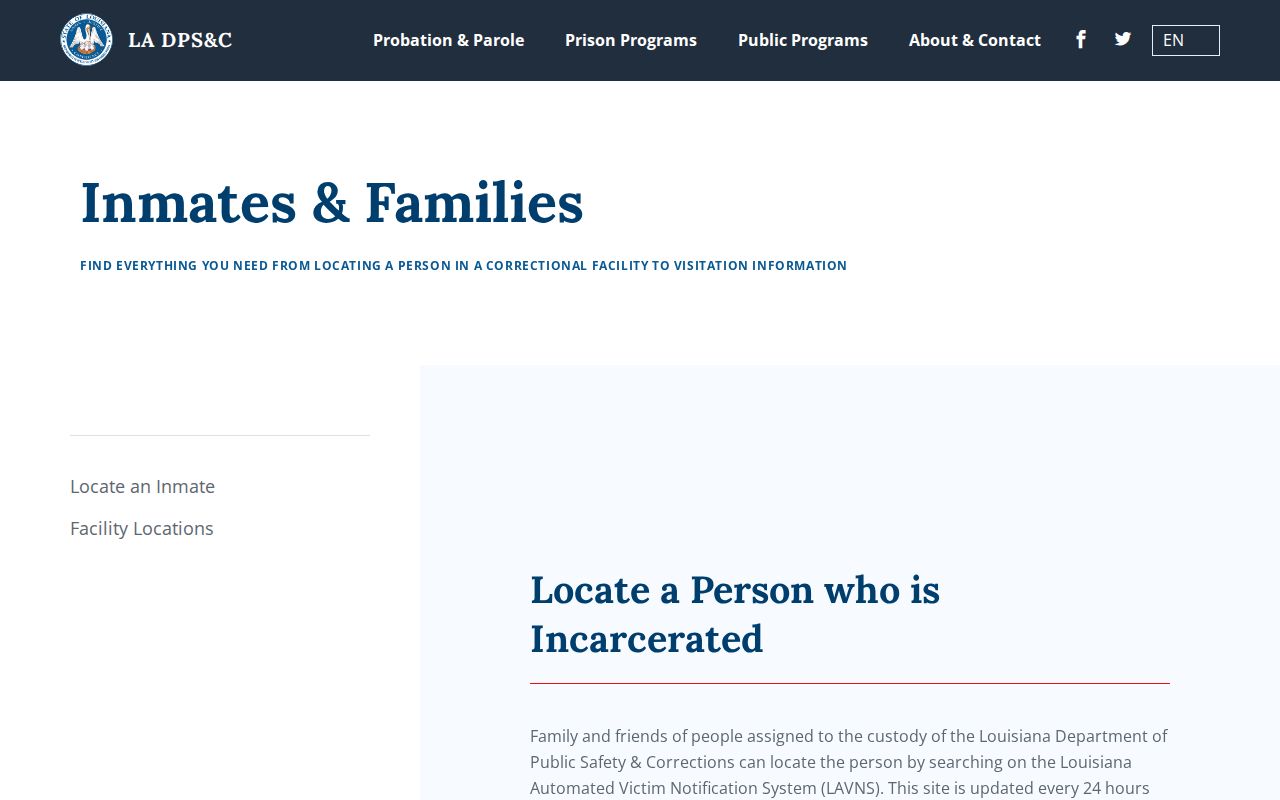
The online path helps identify the current agency and location. The phone locator supplies the projected date field when one has been computed.
Calcasieu Good-Time Release Computation
Louisiana's rule depends first on the offense date. For offenses committed on or after August 1, 2024, R.S. 15:571.3.1 permits eligible felony offenders in parish prison or DPS&C custody to earn good time up to 15 percent of the imposed sentence. This is the source of the common 85 percent shorthand. It is a ceiling for eligible good-time credit, not a promise that each person will leave after exactly 85 percent.
The newer rule excludes sex offenses under R.S. 15:541 and habitual-offender sentences under R.S. 15:529.1. Other sentence terms, credit for time already held, split sentences, forfeiture, and statutory limits can alter the result. The DPS&C Secretary determines the earning and allowance. Discretionary parole under R.S. 15:574.4 is a separate issue and should not be folded into the good-time fraction.
Older offenses may fall under R.S. 15:571.3. The legacy framework differed by parish versus DPS&C sentence, hard-labor status, crime-of-violence classification, and other exclusions. Parish terms without hard labor generally used 30 days of credit per 30 days actually served, while a qualifying first crime of violence used 3 days per 17. Those figures cannot be applied without checking the exact statute version and sentence.
The official R.S. 15:571.3.1 page displays the newer credit ceiling. Its terms must be paired with the offense and sentence record before any Calcasieu Parish projected release date is described.
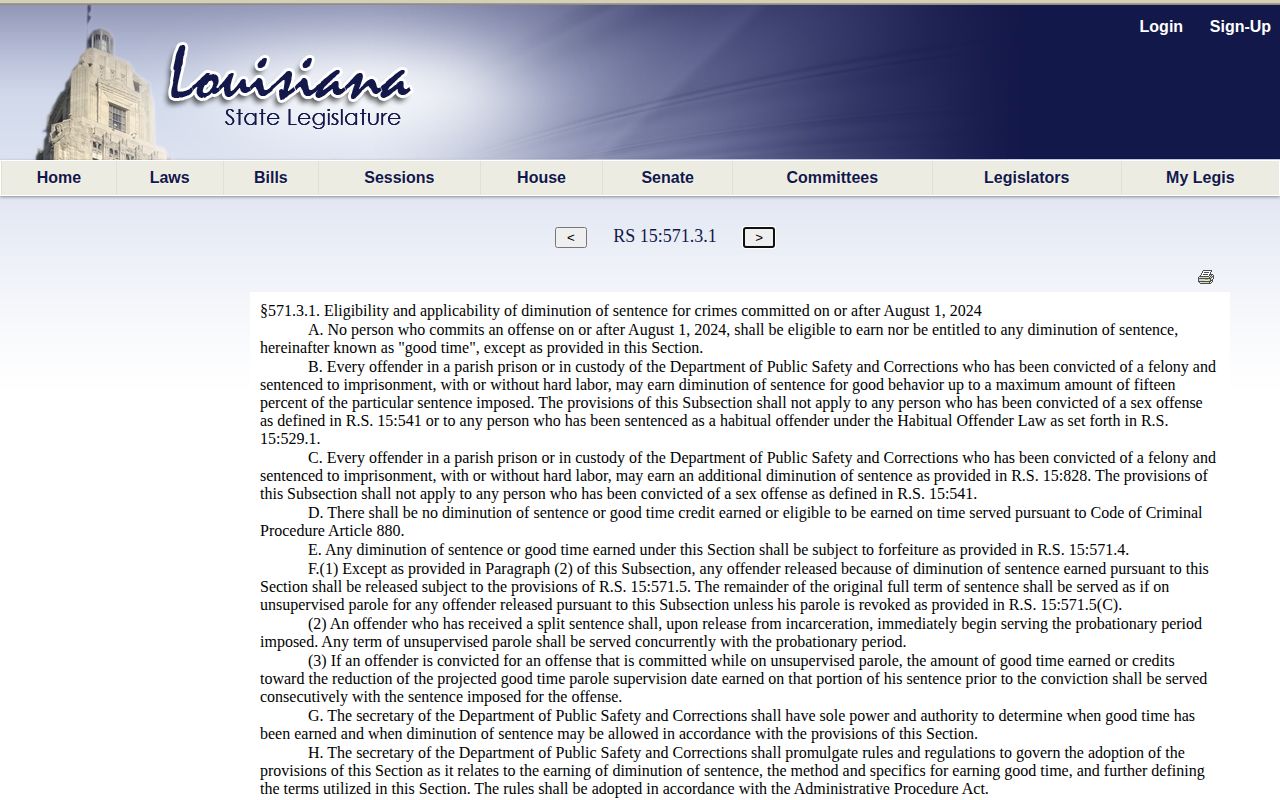
The statute is one input. DPS&C or CPSO must apply it to the actual judgment, credits, exclusions, and disciplinary record.
What Changes Calcasieu Release Dates
The working formula begins with the judicial sentence and lawful commencement or credit date. The agency then identifies the offense-date statute, subtracts credits actually earned and allowed, adds consecutive terms, and accounts for holds or later legal action. A private estimate cannot substitute for that official calculation.
| Factor | Possible effect | Best record |
|---|---|---|
| Sentencing paperwork | No date or a later correction while documents are processed | Certified judgment and DPS&C computation |
| Pre-sentence credit | Changes the lawful time credited toward the term | Court order and agency time record |
| Good-time earning or loss | Moves the projected date as credit is allowed, forfeited, or restored | DPS&C or CPSO sentence record |
| Consecutive or amended term | Adds time or changes the controlling judgment | Later court minutes and judgment |
| Detainer or transfer | Ends custody with one agency but may begin custody with another | Release destination and receiving-agency record |
| Parole action | May authorize a supervised release, subject to plans and holds | Board result plus later DPS&C status |
Program credit, appeals, new sentences, and changes in law may also affect the projection. Louisiana's 24-hour data refresh means a correct change may not appear online at once. When two sources disagree, record each source's date, call the authority doing the computation, and wait for the operative record.
Note: A transfer closes custody at one facility but does not by itself show that the person entered the community.
Confirm Calcasieu Actual Release Dates
Register on the person-specific VINELink Release Check before an expected release when possible. Louisiana VINE supports notices for parish jail and state prison status changes. A release alert is useful evidence, but it is automated and may lag. A facility-change notice can mean transfer rather than freedom.
For a Calcasieu Parish sentence, ask CPSO Records for the booking-linked release date and time, release type, authority, and destination or receiving agency. For a state sentence, request the discharge date and available general sentence information from Louisiana DPS&C. R.S. 15:574.12(G)(1)(a) makes specified general fields available even though the full prison file is confidential.
The DPS&C FAQ gives a separate time-computation line, 225-342-0799, for questions about how a date was calculated. The public-information office should receive a request for existing records, not a demand to create a new calculation. This separation keeps computation issues with the proper unit.
For a written DPS&C request, identify the person, conviction, and sentence and ask for the statutorily available discharge date and general disposition information. Send it to the Deputy Secretary's Office at P.O. Box 94304, Baton Rouge, LA 70804, or docpublicrecords@la.gov. That request seeks an existing historical record. It is not a way to appeal or recalculate time.
Court minutes supply another check. A certified sentencing minute can confirm the imposed term, and a later minute may show an amendment, credit, dismissal, or termination. Calcasieu Clerk online copies are not official; the records in the Clerk's office are. A city-court charge must be checked in the court that handled it rather than assumed to appear in the 14th Judicial District Court index.
Note: State community supervision shows release from incarceration with a sentence still active; a discharge date shows the later historical endpoint.
Calcasieu Parish and State Dates
Calcasieu Correctional Center and Calcasieu Sheriff's Prison share central CPSO records functions, but a DPS&C-sentenced person may remain physically housed in a parish building. The legal custodian determines the calculation. Ask whether the term is a parish sentence or a state sentence before choosing a phone line or record request.
CPSO says its Records Department interprets and administers sentences, calculates parish release and expiration dates, and communicates with courts and correctional agencies about admission and release. That makes CPSO Records the primary local route when a parish calculation is unclear. The state automated locator and time-computation unit handle DPS&C terms.
No official county rule was located for a fixed release time of day, weekend gate practice, or family waiting area. Do not add such assumptions to a projected date. Confirm the status after processing is complete and identify any destination agency.
Release by CPSO can also be a handoff. A detainer may direct the parish jail to notify another authority, and an ICE detainer can request a brief additional hold for pickup. The CPSO date can therefore mark the end of parish custody while another custody period begins. The release record's destination field is essential.
Under R.S. 15:571.5, diminution release can carry continuing legal consequences after incarceration ends. For newer crimes, the good-time remainder may be described as unsupervised parole, while a split sentence can begin a probation term. That status is distinct from both discretionary parole and full discharge, so the post-release label must come from the official record.
The local record request should be just as precise. Give CPSO the person's full name, known aliases, date of birth, booking range, ID, and facility. Ask for existing sentence-calculation or expiration entries and the release fields tied to that booking. CPSO did not publish a fixed production fee or universal turnaround on the accessible request page, so request an estimate and avoid promising a response date.
Louisiana public-records law separates immediate access from a blanket completion deadline. R.S. 44:33 addresses records that are immediately available or actively in use, while R.S. 44:32 permits reasonable copy fees. A disputed withholding requires written exemption reasons. Those provisions do not mean every time-computation file must be produced within the same number of days.
A fully discharged state record may be harder to find in the live locator. In that situation, the written discharge-date request and sentencing court are the historical path. The date should be described as DPS&C's discharge date, not reconstructed from an expired online projection.